The Secret of Shackleton Crater: Why Lunar ISRU is the New Space Race


- Why the lunar south pole has water ice — and where it has been confirmed
- Shackleton Crater: the most strategic 21 kilometers on the Moon
- The lunar night problem — why nuclear fission power is the answer
- From water ice to rocket fuel: how ISRU would work
- NASA vs. China: overlapping targets and unresolved law
- Frequently asked questions
The Moon's south pole has become the most strategically important destination in the new space race — and the reason is straightforward: water. Confirmed frozen water deposits in permanently shadowed craters near the pole could support life-support systems, sustain long-duration surface bases, and, if extracted and processed at scale, be converted into rocket propellant for missions extending far beyond the Moon itself.
That single resource explains why NASA's Artemis program and China's Chang'e-7 mission are both targeting the same cold, shadow-filled region near the lunar south pole. They are chasing the same physics, in the same narrow zone. This article covers what makes the lunar south pole uniquely strategic, why water ice survives there in abundance, how engineers plan to convert it into fuel, and what the convergence of two competing programs means for international space law.
Science fiction has occasionally anticipated these dynamics more clearly than policy papers. In Ad Astra, Brad Pitt navigates a Moon that functions less like a monument and more like a forward operating base — serving the interests of nations and corporations that never appear on screen. That near-future scenario now feels plausible. America's lunar ambitions began as a competition with the Soviet Union. The competitor has changed. The logic has not.
- Water ice confirmed at ~5.6 wt% in Cabeus crater, measured directly in the LCROSS ejecta plume (Colaprete et al., Science, 2010)
- PSR floor temperatures reach −233 to −248 °C — among the coldest confirmed environments in the solar system (Paige et al., Science, 2010)
- Shackleton's rim receives sunlight 80–90% of the year; its floor has likely seen none in a billion years
- NASA's Fission Surface Power program targets 40 kW continuous output for 10+ years — enough to sustain a base through unbroken lunar night
- NASA and China are targeting the same south-pole zone — with no binding mechanism to resolve what happens when their operations overlap
Why the Lunar South Pole Has Water Ice — And Where It Has Been Confirmed
The south pole draws missions because of what sits inside its shadows: water ice. Not metaphorically — literally frozen water, confirmed by multiple independent instruments across several decades of observation. The reason it survives there comes down to a fundamental quirk of geometry: the Moon's rotational axis is tilted only about 1.54 degrees relative to the ecliptic — the plane of Earth's orbit around the Sun — compared with Earth's own 23.4-degree tilt, the one that gives us seasons. Because that axis sits almost upright, the Sun never climbs more than about a degree and a half above the horizon at the lunar poles. The floors of certain deep craters, screened by their own rims, therefore receive no direct sunlight — ever.
NASA's Lunar Prospector mission mapped hydrogen concentrations across these permanently shadowed regions (PSRs) — crater floors that, because of that small axial tilt, never receive direct sunlight — using neutron spectroscopy, identifying enhancements at both poles consistent with water ice trapped in the regolith (Feldman et al., Science, 1998). India's Chandrayaan-1 spacecraft, carrying NASA's Moon Mineralogy Mapper (M3) instrument, then provided direct near-infrared spectral signatures of surface ice on polar crater floors — a different detection method, yielding the same conclusion (Pieters et al., Science, 2009).
The most direct confirmation came from NASA's LCROSS mission, which deliberately crashed a rocket stage into Cabeus crater near the south pole in 2009 and analyzed the resulting ejecta plume. The plume showed water at concentrations of approximately 5.6 ± 2.9 weight-percent (Colaprete et al., Science, 2010) — not trace amounts, but measurable ice mixed into the regolith at levels that matter for extraction planning.
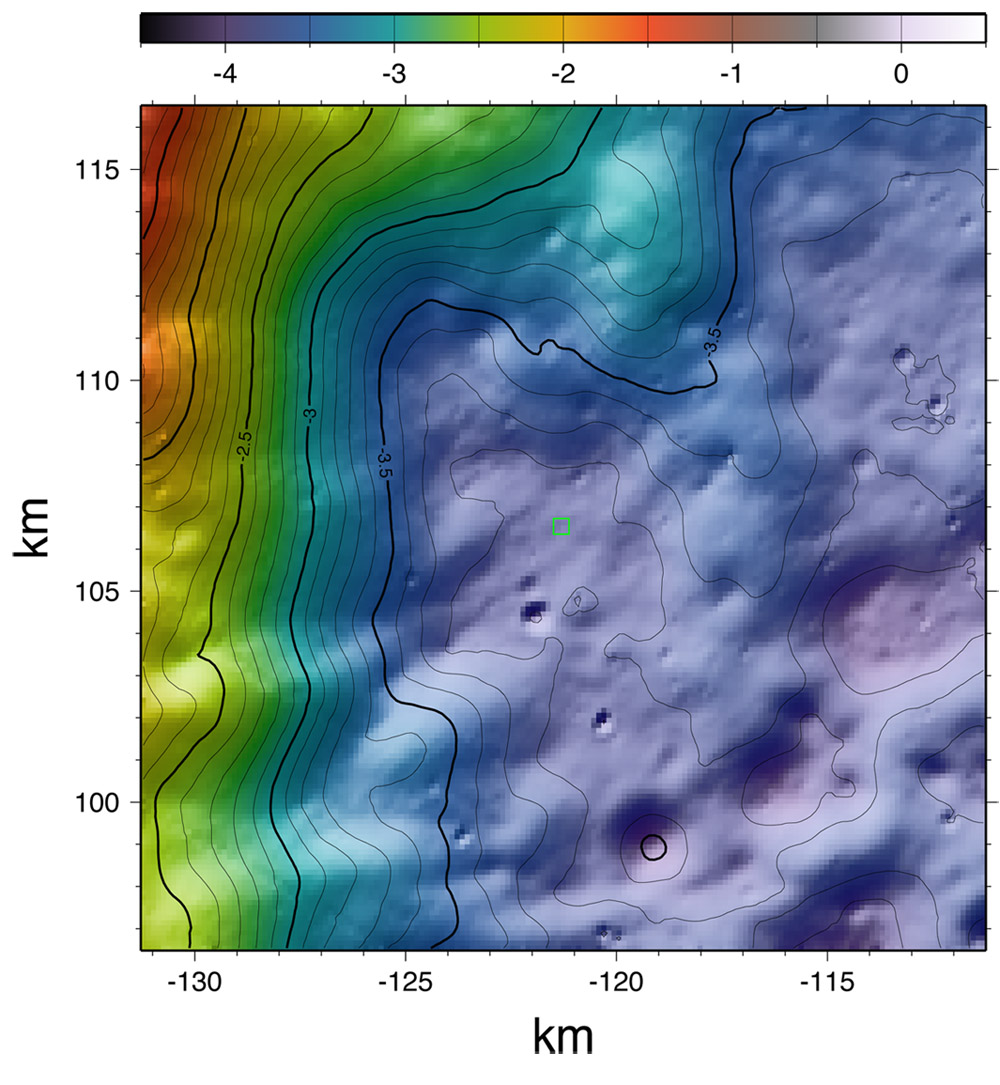
Topographic map of Cabeus crater — the LCROSS impact site where water was confirmed at ~5.6 wt% in the ejecta plume. The crater's permanently shadowed floor (shown in dark blue) maintains temperatures near −248 °C, cold enough to trap ice for billions of years. Credit: NASA LRO / LOLA
It is worth being precise here: water ice is found in permanently shadowed polar regions at both the lunar south and north poles, not exclusively at the south pole. The south pole has attracted greater mission focus primarily because of specific topographic advantages — particularly Shackleton crater's geometry — and because the LCROSS direct confirmation came from Cabeus, located near the south pole specifically (Hayne et al., Nature Astronomy, 2020).
The temperatures inside these craters explain why that ice has remained in place. NASA's LRO Diviner instrument records PSR floor temperatures as low as approximately 25–40 K (roughly −233 °C to −248 °C) — among the coldest confirmed environments in the entire solar system (Paige et al., Science, 2010). At those temperatures, water molecules that migrated into shadow billions of years ago have never had enough energy to escape.
Contrast that with the lunar equator, where daytime surface temperatures exceed approximately 120 °C (Vasavada et al., Icarus, 2012). Ice there cannot remain stable over geologically meaningful timescales. PSRs near the poles are the only locations on the Moon where ice can accumulate in quantities worth discussing.
Estimates of the total water ice mass trapped in lunar PSRs vary widely depending on the modeling approach. NASA's original 1998 Lunar Prospector analysis cited concentrations consistent with up to an estimated 6 billion metric tons; later work using different assumptions and larger survey datasets produced a broader range, sometimes cited as 1 to 10 billion metric tons. All figures carry substantial uncertainty and are based on orbital survey modeling rather than ground-truth measurement. The ice is buried, unevenly distributed, and mixed with regolith in ways that in-situ surveys have not yet resolved. But even the conservative end of any of these estimates represents a resource large enough to change how engineers think about what is operationally possible on the Moon.
Shackleton Crater: The Most Strategically Valuable 21 Kilometers on the Moon
Among all the craters near the south pole, Shackleton has become the focal point for mission planners — and the geometry of the place explains why.
Shackleton sits almost exactly at the lunar south pole, with the pole itself lying on the crater's rim. It is approximately 19 to 21 kilometers wide and more than 4 kilometers deep, with steep inner walls and a bowl-shaped floor that LROC imaging confirms is in near-permanent shadow (Spudis et al., 2013). The Lunar Reconnaissance Orbiter's illumination data shows that certain elevated points on Shackleton's rim receive sunlight more than 80 to 90 percent of the time over a lunar year — no single point is permanently illuminated, but the best ridgelines come close.
Put another way: the rim basks in near-constant sunlight. The floor, just a few kilometers below, has not seen a single ray of it in perhaps a billion years. That vertical contrast — a sun-drenched ridge above a cryogenic abyss — is exactly the combination mission planners have been looking for.
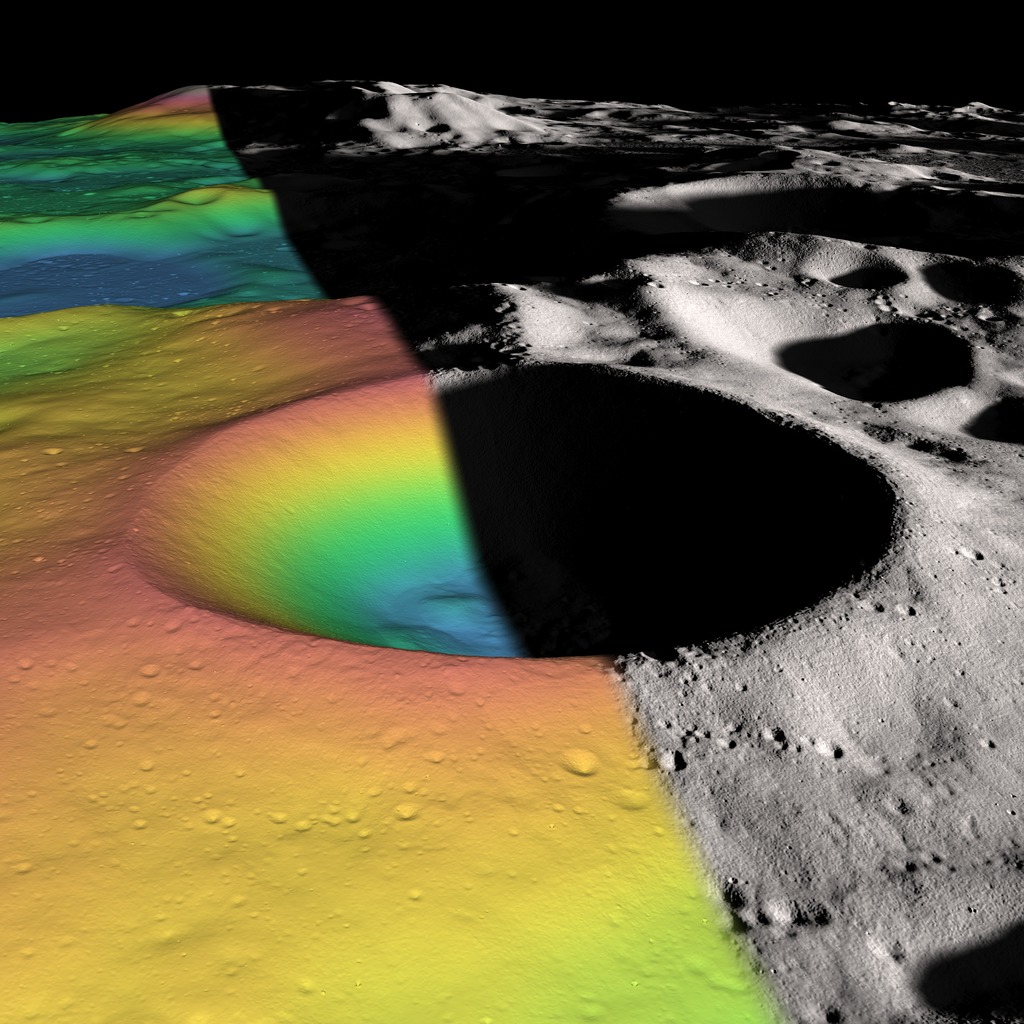
Shackleton Crater at the lunar south pole. False-color elevation: red = sunlit rim, blue = permanently shadowed floor. The vertical contrast between these two zones is the core reason both Artemis and Chang'e-7 center their planning here. Credit: NASA SVS / LRO
A base positioned on the rim could run solar panels at near-continuous capacity while staying within reach of ice deposits in the crater below — the closest thing to an integrated power-and-water combination available anywhere on the lunar surface.
The ice situation inside Shackleton itself is more nuanced than early reports suggested. A 2025 analysis published in the Journal of Astronomy and Space Sciences examined ShadowCam and M3 data and found that the high reflectance observed in Shackleton's permanently shadowed interior is more consistent with plagioclase-rich rock and mass-wasting material than with large sheets of water ice. That does not rule out ice in the regolith, but it does mean substantial ice deposits inside Shackleton specifically remain unconfirmed.
A March 2026 study in Science Advances (University of Hawaiʻi at Mānoa) extended this picture across PSRs more broadly: orbital analysis found no evidence of widespread surface ice at concentrations above roughly 20–30 weight-percent across the south-pole region — consistent with small isolated pockets rather than accessible surface sheets. Subsurface ice below the uppermost regolith layer remains possible and is not ruled out by the study. Together, these findings reinforce the scientific consensus that south-pole ice extraction will likely require drilling or excavation rather than simple surface scraping. The water-ice case at the south pole rests on the broader network of PSR craters in the region — with Cabeus as the directly confirmed site — not on any single crater's floor in isolation.
Nevertheless, NASA identified "Peak Near Shackleton" as one of its original 2022 Artemis III candidate landing regions, and China's Chang'e-7 mission has listed the illuminated rim of Shackleton crater as its preferred landing area, with published coordinates near approximately 88.8°S, 123.4°E. Both programs have converged on the same broader south-pole strategic zone — a convergence driven by the same physics of rim illumination and adjacent PSR ice potential.
The Lunar Night Problem — Why Nuclear Fission Power Is Currently the Most Practical Solution
The south pole's sunlit ridges are promising, but they do not solve everything. The fundamental challenge of sustained lunar operations is surviving the periods when the Sun disappears — and those periods are long.
At equatorial latitudes, the lunar day-night cycle follows the synodic period of approximately 29.5 Earth days: roughly 14 days of daylight, then roughly 14 days of darkness. Near the poles, topography modifies this considerably. The best-illuminated ridges near Shackleton experience shorter darkness intervals than equatorial sites, but even the most favorable locations have multi-day blackout periods caused by libration and seasonal shifts in the Sun's angle. No location on the Moon is permanently sunlit.
During those blackout intervals, temperatures across most of the lunar surface drop to approximately −130 °C. Equipment not actively heated will fail. Batteries, electronics, seals, and mechanical components all have operational limits that lunar night routinely exceeds.
Surviving 10 to 14 or more days of darkness on batteries or fuel cells alone requires storing an immense amount of energy — and every kilogram of that storage has to be launched from Earth at steep cost. For early missions, that mass budget simply is not there. For permanent installations, it is a structural problem that batteries alone cannot solve — not at any launch mass that makes operational sense. That said, solar power will almost certainly play a role in any south-pole architecture; the point is that it cannot carry the full load.
NASA's response is the Fission Surface Power (FSP) program, developed in partnership with the U.S. Department of Energy. According to NASA program documentation and Westinghouse Electric Company's January 2025 contract announcement with Idaho National Laboratory, the FSP program is developing a small fission reactor intended for lunar surface demonstration, targeting approximately 40 kilowatts of continuous electrical power for at least 10 years. Forty kilowatts is enough to power roughly 30 average U.S. homes — and, more practically, enough to run life support, heating, communications, and early ISRU operations through an unbroken lunar night.
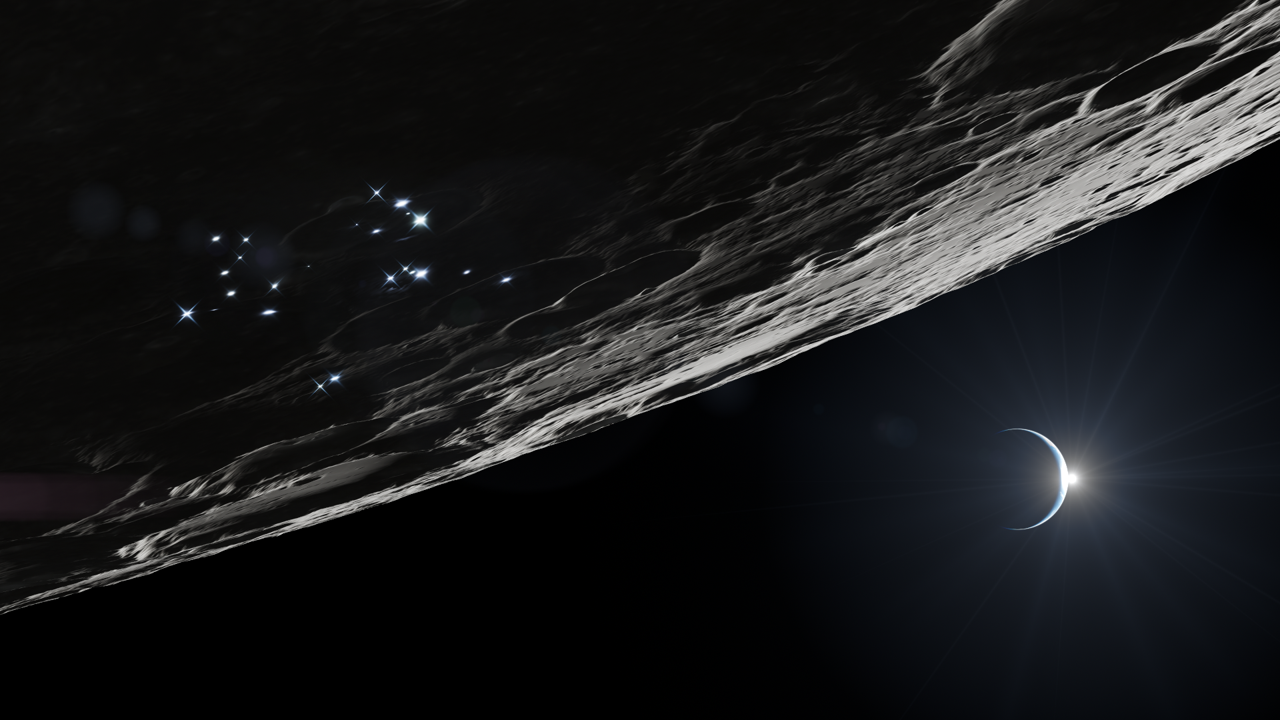
The lunar south pole environment — target site for NASA's Fission Surface Power demonstration. With Earth visible on the horizon, a base here must survive roughly two weeks of total darkness per cycle. Solar power alone cannot carry that load. Credit: NASA
NASA's Glenn Research Center leads the program, with Marshall Space Flight Center also involved. Westinghouse Electric Company holds an active contract for space microreactor concept development under the FSP project, with a contract extension announced in January 2025. Under a 2020 NASA-DOE MOU, DOE leads reactor development while NASA leads mission integration. The program targets a lunar surface demonstration within the next decade, broadly aligned with Artemis base-camp planning timelines.
From Lunar Water Ice to Rocket Fuel: How ISRU Would Work — and Why It Changes Everything
The reason water ice at the south pole matters to mission planners goes well beyond drinking water or radiation shielding. Water, split into its component elements and cooled to liquid form, becomes one of the highest-performing rocket propellant combinations known: liquid oxygen (LOX) and liquid hydrogen (LH2). Lunar ice could, in principle, be refined into fuel for missions departing the Moon — or stored in cislunar depots to supply spacecraft that never need to carry propellant up from Earth's surface at all.
A NASA NTRS technical assessment on in-situ resource utilization (ISRU) — the process of producing usable materials directly from local resources rather than launching them from Earth — describes the basic production chain: water is extracted from icy regolith, purified, and split into hydrogen and oxygen via electrolysis. Two electrolysis approaches are under study: proton-exchange membrane (PEM) systems, which require high-purity water input, and solid-oxide electrolysis (SOE) systems, which operate at higher temperatures and tolerate less-pure feedstock. SOE systems require on the order of 38 kilowatt-hours of electrical energy per kilogram of hydrogen produced — a figure that ties directly to the FSP program's power requirements.
NASA's ISRU technology maturation roadmap, documented across multiple NTRS technical reports, describes a scaling pathway from kilowatt-class demonstration units to megawatt-class industrial systems capable of producing tens of kilograms of propellant per hour — a transition from proof-of-concept to the kind of sustained throughput that would actually support regular departure operations from the lunar surface.
The underlying logic is what engineers sometimes call "breaking the tyranny of the rocket equation." The Moon's surface gravity is roughly one-sixth of Earth's, meaning propellant manufactured on the Moon and used for lunar departure costs far less in energy terms than equivalent propellant launched from Earth. Even a small fraction of the estimated water ice reserve, if converted to propellant, could support a substantial number of missions without Earth resupply. That is the architecture behind long-range Mars and deep-space planning — the Moon not as a destination, but as a waystation with its own fuel supply.
That is the moment the Moon stops being a distant object in the sky and starts becoming infrastructure. A refueling depot. A logistics hub. A forward strategic platform. The engineering behind that shift is genuinely brilliant — and something about it is worth letting sink in. Why the Moon matters to Earth in the first place is a different question — but not an unrelated one.
NASA vs. China at the Lunar South Pole: Overlapping Targets and Unresolved Law

The 13 original candidate landing regions near the lunar south pole. China's Chang'e-7 is drawn to the same broader zone by the same underlying physics. Credit: NASA Scientific Visualization Studio
NASA's Artemis program has been moving fast. In April 2026, Artemis II completed a crewed lunar flyby — the first humans to travel to the Moon since Apollo 17 in 1972. The south-pole landing timeline, however, shifted in February 2026 when NASA Administrator Jared Isaacman redesignated Artemis III as a crewed Human Landing System test in low Earth orbit (targeted for 2027), moving the first crewed south-pole landing to Artemis IV, currently planned for early 2028.
The candidate landing regions originally announced for Artemis III are expected to remain the target zones for the eventual Artemis IV crewed landing. The first round, in 2022, identified thirteen candidate regions near the south pole, including Faustini Rim A, Peak Near Shackleton, Connecting Ridge, de Gerlache Rim 1 and 2, Haworth, Malapert Massif, Leibnitz Beta Plateau, Nobile Rim 1 and 2, and Amundsen Rim. A 2024 update narrowed the list to nine regions: Peak near Cabeus B, Haworth, Malapert Massif, Mons Mouton Plateau, Mons Mouton, Nobile Rim 1, Nobile Rim 2, de Gerlache Rim 2, and Slater Plain.
China's Chang'e-7 mission, planned for the second half of 2026 — with August frequently cited as the target — is designed specifically as a south-pole water-hunting mission. Its stated preferred landing area is the illuminated rim of Shackleton crater. Both programs have settled on the same narrow band of south-pole terrain because the same pairing of rim illumination and adjacent PSR ice applies regardless of which flag is planted there.
| Program | Target Area | Key Mission | Timeline |
|---|---|---|---|
| NASA Artemis | 9 candidate regions near south pole (2024 list) | Artemis III: crewed HLS test in low Earth orbit (redesignated Feb 2026); Artemis IV: first crewed south-pole landing; FSP demonstration | Artemis III HLS test: 2027; Artemis IV crewed landing: early 2028; FSP demo: within the decade |
| China Chang'e-7 | Illuminated rim of Shackleton crater (~88.8°S, 123.4°E) | South-pole water-ice survey; mini flying probe for PSR sampling | Launch planned: second half of 2026 (August target) |
The legal framework meant to manage that proximity is contested. The Artemis Accords — 67 nations strong as of May 2026, per the U.S. Department of State — include provisions for "safety zones" — activity-specific areas around operations intended to prevent interference. These zones are explicitly framed as non-sovereign and temporary, drawing their legal basis from Article IX of the 1967 Outer Space Treaty, which requires states to conduct activities with "due regard" to other parties and to avoid "harmful interference." The Artemis Accords themselves are not a treaty; they are a multilateral political agreement — what international law scholars classify as soft law. China has not signed the Accords.
Some legal scholars argue that the safety zones as described go beyond what the Outer Space Treaty's "due regard" language actually authorizes; others argue they represent a reasonable operationalization of existing obligations. The disagreement remains unresolved, and no binding dispute-resolution mechanism currently exists for competing national operations at the same geographic location on the Moon — a legal gap with familiar parallels in Earth orbit, where responsibility for debris collisions remains equally unsettled.
What the table does not capture is the degree to which both programs have arrived at the same narrow zone using the same scientific reasoning: maximum solar illumination on the rim, maximum ice potential in the adjacent PSRs below. The physics will not change to accommodate two separate sets of national plans — and the legal tools for resolving what happens when they overlap do not yet exist.
I grew up looking at the Moon the way most people did — with wonder, not strategy. The shift from one to the other happened quietly, somewhere between Apollo and Artemis, and I'm not sure any generation was given a clear moment to notice it. The hope, however naive, is that the next generation still gets to look up and see something that belongs to everyone. Whether that remains possible is not a scientific question. It is a political one, and it is still open.
Frequently Asked Questions
Has water ice actually been confirmed on the Moon, or is it still speculation?
Multiple independent instruments have confirmed water ice near the lunar south pole. NASA's LCROSS mission directly measured water at concentrations of approximately 5.6 ± 2.9 weight-percent in the ejecta plume from a controlled impact into Cabeus crater in 2009 (Colaprete et al., Science, 2010). India's Chandrayaan-1 M3 instrument independently detected near-infrared spectral signatures of surface ice on polar crater floors using a different detection method (Pieters et al., Science, 2009). When two independent techniques arrive at the same conclusion, that is what distinguishes confirmed evidence from speculation.
What is a permanently shadowed region (PSR), and why does it matter for water ice?
A permanently shadowed region (PSR) is a crater or depression near a lunar pole whose floor never receives direct sunlight. Because the Moon's rotational axis is tilted only about 1.54 degrees relative to the ecliptic — compared with Earth's 23.4-degree tilt — the Sun barely rises above the horizon at the poles, leaving deep crater floors in permanent shadow. Temperatures in these zones fall to approximately −233 °C to −248 °C — cold enough that water ice deposited billions of years ago has never acquired sufficient thermal energy to escape (Paige et al., Science, 2010). PSRs are the only locations on the Moon where ice can remain stable over geologic timescales.
Why does the lunar south pole matter more than the north pole or equatorial regions?
Both poles contain water ice in permanently shadowed regions — the south pole is not uniquely endowed. The south pole has attracted greater mission attention primarily because of specific topographic advantages: the combination of Shackleton crater's large, well-shadowed PSR floor and the high solar illumination rates on adjacent ridgelines creates the most favorable known pairing of power access and ice proximity on the Moon. The LCROSS direct ice confirmation also came specifically from Cabeus, near the south pole.
Are the Artemis Accords legally binding on China?
No. The Artemis Accords are classified in international law as soft law — a politically binding multilateral agreement, not a formal treaty — and China has not signed them. As of May 2026, 67 nations have signed the Accords, per the U.S. Department of State. The binding framework governing space activities remains the 1967 Outer Space Treaty. The safety zone provisions in the Accords are themselves legally contested, with some scholars arguing they extend beyond what the Outer Space Treaty's "due regard" language authorizes. No binding dispute-resolution mechanism currently exists for competing national operations at the same lunar location.
Why can't solar panels alone power a permanent south-pole lunar base?
Even the best-illuminated ridges near Shackleton crater experience multi-day darkness periods due to libration and seasonal shifts in the Sun's angle. No location on the Moon is permanently sunlit. Bridging those blackout intervals using batteries or fuel cells alone requires storing an enormous amount of energy — energy that must be launched from Earth at substantial cost. NASA's Fission Surface Power program targets 40 kilowatts of continuous electrical output for at least 10 years, making it currently the most practical large-scale solution for sustained operations through lunar night. Solar power will likely supplement, not replace, this baseline capacity.
Sources & References
- Colaprete, A. et al. (2010). Detection of Water in the LCROSS Ejecta Plume. Science, 330(6003), 463–468. doi:10.1126/science.1186986
- Pieters, C. M. et al. (2009). Character and Spatial Distribution of OH/H₂O on the Surface of the Moon Seen by M3 on Chandrayaan-1. Science, 326(5952), 568–572. doi:10.1126/science.1178658
- Paige, D. A. et al. (2010). Diviner Lunar Radiometer Observations of Cold Traps in the Moon's South Polar Region. Science, 330(6003), 479–482. doi:10.1126/science.1187726
- Feldman, W. C. et al. (1998). Fluxes of Fast and Epithermal Neutrons from Lunar Prospector. Science, 281(5382), 1496–1500. doi:10.1126/science.281.5382.1496
- Hayne, P. O. et al. (2020). Micro cold traps on the Moon. Nature Astronomy, 5, 169–175. doi:10.1038/s41550-020-1198-9
- Vasavada, A. R. et al. (2012). Lunar equatorial surface temperatures and regolith properties from the Diviner Lunar Radiometer Experiment. Journal of Geophysical Research: Planets, 117, E00H18. doi:10.1029/2011JE003987
- Spudis, P. D. et al. (2013). Evidence for water ice on the Moon: Results for anomalous polar craters from the LRO Mini-RF imaging radar. Journal of Geophysical Research: Planets, 118(10), 2016–2029. doi:10.1002/jgre.20156
- Li, S. et al. (2026). Searching for surficial water ice in lunar permanently shaded regions with ShadowCam. Science Advances, 12, eads3155. doi:10.1126/sciadv.ads3155
- NASA Artemis Candidate Landing Regions (2022 & 2024 update): nasa.gov/artemis-iii-regions
- NASA Technical Reports Server — Lunar ISRU assessments: ntrs.nasa.gov
- NASA Fission Surface Power Program: nasa.gov — FSP Program
- Westinghouse Electric Company — Space microreactor contract continuation (January 2025, via Idaho National Laboratory / NASA-DOE FSP program): info.westinghousenuclear.com
- JASS (2025) — Shackleton ShadowCam & M3 analysis: janss.kr
- The Planetary Society — Chang'e-7 mission profile: planetary.org/chang-e-7
- Outer Space Treaty (1967) full text: unoosa.org
- Artemis Accords — NASA (signatories & full text): nasa.gov/artemis-accords
- LROC — Shackleton crater imaging & illumination data: lroc.im-ldi.com
About this article: Written by James for thesecom.net. Last updated: May 31, 2026. Research drew on NASA technical publications, peer-reviewed journal sources (with DOI links), and primary mission documentation. All cited sources were verified against their primary URLs at time of publication. Scientific understanding of lunar resources continues to evolve as new mission data becomes available; readers are encouraged to consult primary sources for the most current information.
Disclaimer: This article is provided for educational and informational purposes only. It summarizes publicly available research and the author's personal observations at time of writing. Nothing in this article is intended as professional advice of any kind.


Comments
Post a Comment