Was the Moon Landing Fake? The Soviets Had Every Reason to Say Yes — and Said Nothing

Was the Moon landing fake, or did it really happen?
It really happened. Six Apollo crews landed between 1969 and 1972, and the confirmation comes from laboratories, observatories, and spacecraft outside NASA's control — including Soviet hardware still sitting on the lunar surface.
The harder question is why the hoax theory outlives all of it. That turns out to be about psychology, not photography.
Published: April 26, 2026 | Last updated and reviewed: September 3, 2026 | 10 min read
Apollo 11 happened before I was born. I met it the way you meet the Battle of Hastings — in a history class, as a finished fact with a date attached. By the time I was old enough to care, in the 1980s, the pictures were already old: grainy, washed out, slow. Less like footage of an event than like a legend somebody had managed to film.
Even so, I have never understood the insistence that the whole thing was staged. People spent centuries reaching for the Moon before anyone got there. Cyrano de Bergerac, Jules Verne, and Edgar Allan Poe each invented a way to travel to it. Leonardo da Vinci, working on something else entirely, figured out why the dark part of a crescent Moon still glows faintly — it is lit by sunlight bouncing off the Earth. Then, between 1969 and 1972, six crews actually went, and some of them lived long enough to describe it to anyone who asked. Out of that whole long chain, the hoax theory rejects exactly one link: the only one we can still go outside and measure.
Related reading: Edgar Allan Poe Imagined Space Life — how writers envisioned voyages beyond Earth long before any rocket ever flew.
Why Do People Think the Moon Landing Was Fake?
Here is the thing I keep circling back to. In April 2026, Artemis II flew four astronauts around the far side of the Moon and home again — the first crewed lunar mission since Apollo 17 in 1972, tracked live and filmed with modern cameras. Within days, hashtags like "fake space" were spreading across X, TikTok and Facebook, along with an AI-manipulated image purporting to show the crew floating in front of a green screen, as AFP's fact-checkers documented at the time. If fresh, high-resolution footage doesn't settle the question, the question was never really about footage. So the more useful thing to ask isn't what would convince a skeptic. It's why the belief survives the evidence in the first place — and that is a question about psychology, not photography.
Psychologists who study conspiracy belief tend to sort the motives into three groups: existential (the need to feel in control of an uncertain world), social (the appeal of belonging to a group that knows what others don't), and epistemic (a preference for explanations that feel clean and complete). Douglas et al. (2017) laid this out in Current Directions in Psychological Science, and van Prooijen (2020) extended it. For someone who already assumes official accounts are false by default, the Moon hoax slots into place without any effort at all.
There is also a striking finding about who believes it. Acceptance of the Moon-landing conspiracy correlates less with anything specific to Apollo than with a general conspiracist worldview — the tendency to hold several unrelated conspiracy theories at once. Some work has linked it to traits associated with magical or unusual thinking (Darwin et al., 2011, Personality and Individual Differences). Which suggests the belief isn't really an argument about lunar photography. It is a disposition that happened to land on lunar photography, and once it lands, like-minded company keeps it safe from scrutiny.
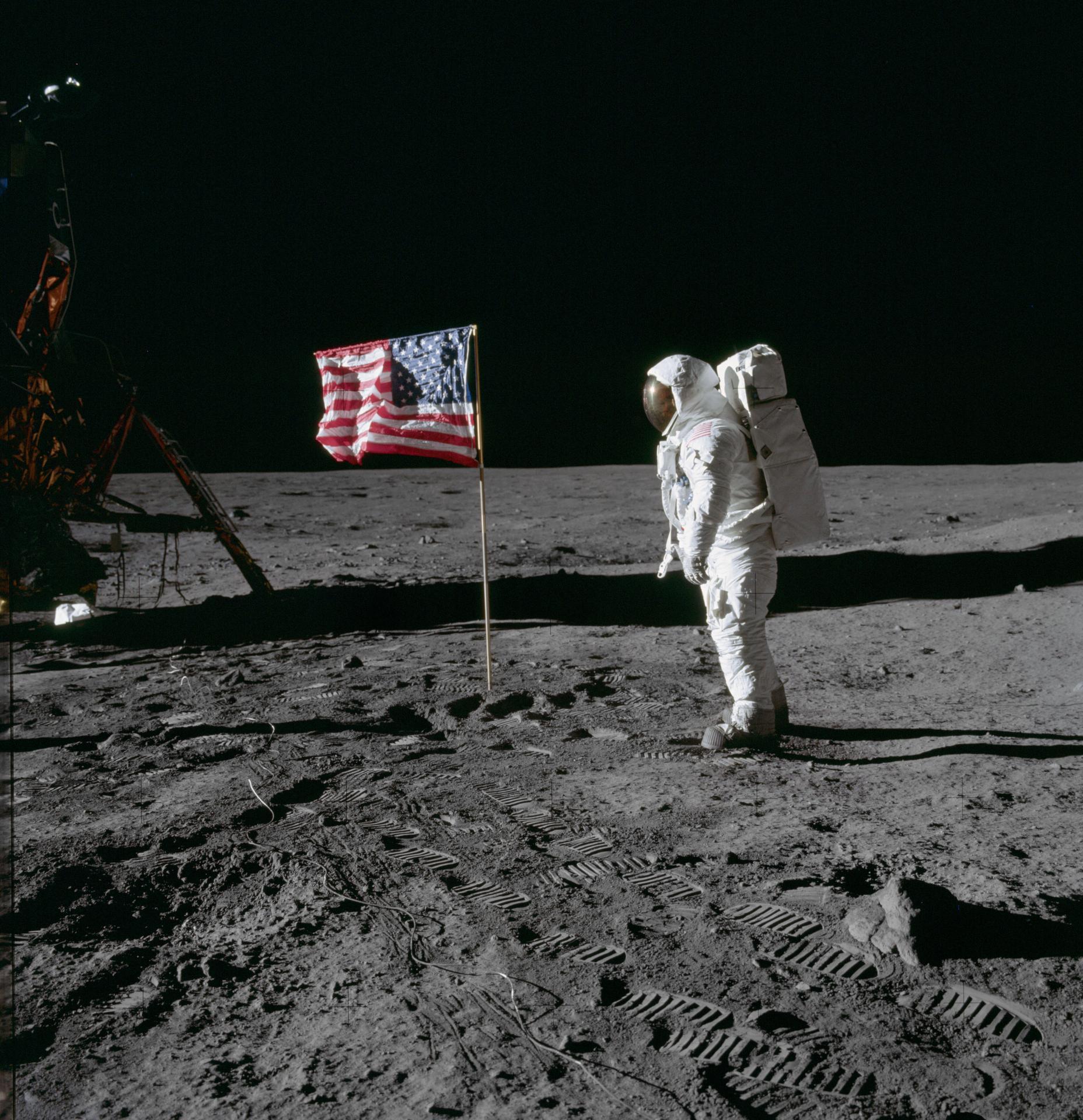
Buzz Aldrin on the lunar surface, July 20, 1969 — photographed by Neil Armstrong. The flag's top edge is hemmed into a sleeve with a rod running through it; without the rod, the fabric would simply hang. The famous "waving" came from the astronauts twisting the pole as they planted it, and in a vacuum there is no air to slow a swing once it starts. In still photographs, the rod and the creases from storage finish the illusion. Photo: NASA (public domain).
The Cognitive Biases That Make the Moon Landing Hoax Feel Convincing
That flag is the most instructive object in the whole story, because for a split second it really does look wrong. And that flicker of that's strange is the engine the theory runs on. Once it fires, everything afterward gets sorted into two piles: anomalies go in the pile marked evidence, explanations go in the pile marked excuses. Psychologists call the sorting confirmation bias, and the Moon hoax may be its cleanest illustration — the shadows that seem to converge, the black sky with no stars in it, the flag. Each has a physical explanation that takes about a paragraph to give. None of those paragraphs travel as far as the anomaly does.
Two other biases show up consistently in the research. Proportionality bias is the tendency to assume that a large, consequential event must have a large, hidden cause — which makes a government conspiracy feel more satisfying than a successful engineering program. Pattern perception drives people to read deliberate deception into photographic artifacts and routine technical quirks that have entirely mundane explanations.
Framing matters too. Lewandowsky et al. (2012), writing in Psychological Science in the Public Interest, found that factual corrections can reduce a false belief, while exposure to pro-conspiracy framing tends to deepen it. That asymmetry is the trap. Once someone has filed Apollo under propaganda, ambiguous details stop being puzzles to solve and start serving as proof that the cover-up is working.
Where Did the Moon Landing Hoax Theory Come From?
What surprised me most, tracing the theory back to where it started, is how small the starting point turns out to be. A large share of what circulates today descends from one self-published paperback: We Never Went to the Moon: America's Thirty Billion Dollar Swindle, put out in 1976 by a man named Bill Kaysing. His credential — the one repeated in every retelling — is that he worked at Rocketdyne, the company that built the Saturn V's F-1 engines. What the retellings leave out is the job. Kaysing worked in technical publications there from 1956 until 1963, writing and editing documents. Accounts differ on his exact title; none of them place him in engineering. His degree was in English. And his argument was that landing on the Moon was essentially impossible, so faking it must have been the easier path. That inversion became the template for much of what followed.
The claim that NASA hired Stanley Kubrick — director of 2001: A Space Odyssey — to shoot the fake footage also begins with Kaysing. What carried it further was Capricorn One (1978), a thriller about a faked Mars landing. The film has nothing to do with Kubrick and nothing to do with the Moon, but it put a vivid, concrete picture of a staged NASA mission into a great many heads, and the story had somewhere to live afterward. No record has ever tied Kubrick to a NASA production of any kind. The rumor survives on one coincidence: his film showed that a convincing lunar set could be built, and people have projected that backward onto the real footage.
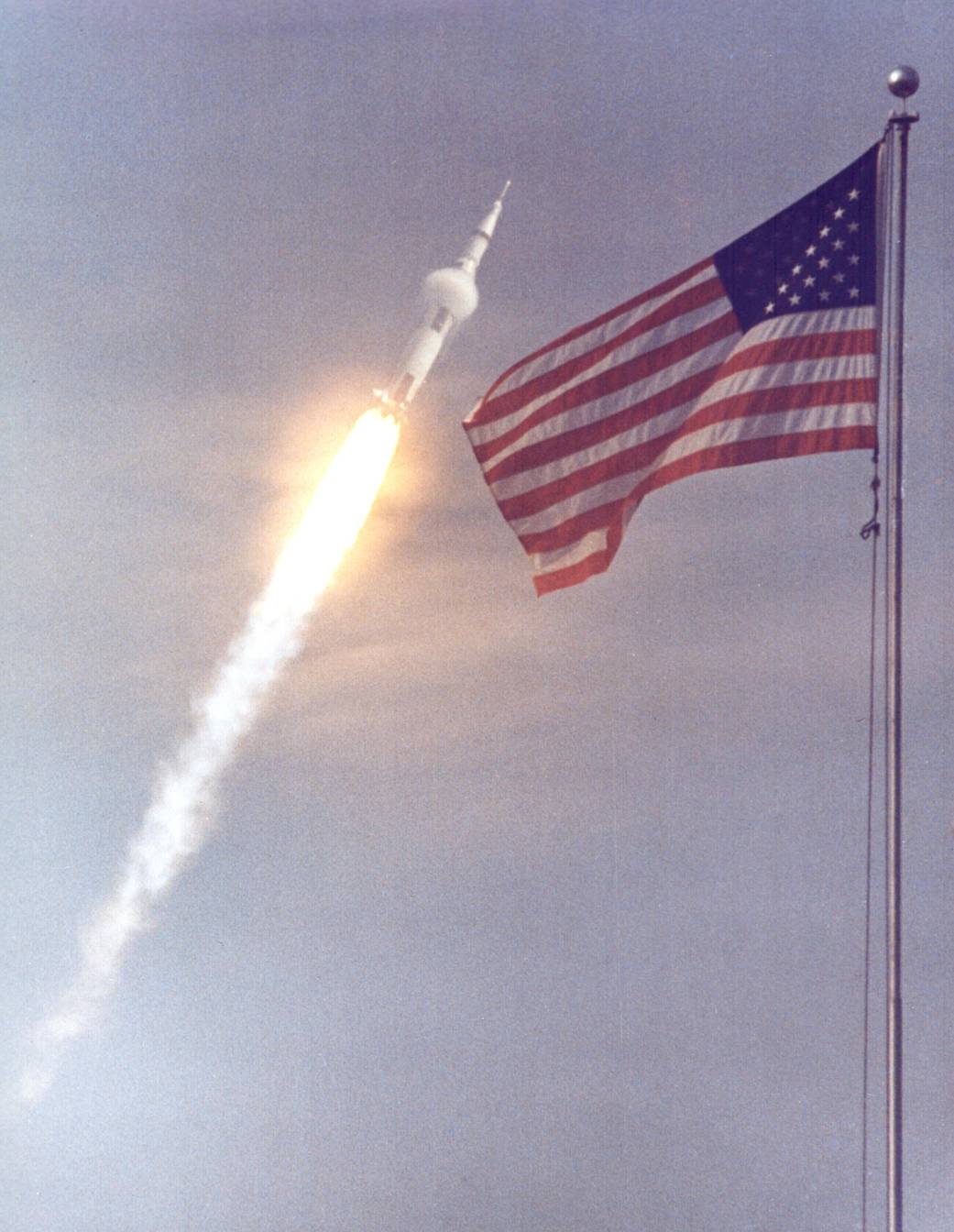
The Saturn V rocket carrying Apollo 11 lifts off from Kennedy Space Center, July 16, 1969. The launch was witnessed by an estimated one million spectators along the Florida coast, and tracked by radar stations on multiple continents. Photo: NASA (public domain).
The Cold War Argument for the Moon Landing Hoax
This is the strand of the hoax theory I find hardest to get past, and it has nothing to do with anything NASA said. One of the more persistent versions holds that the United States had every reason to lie: winning the Space Race, delivering on Kennedy's end-of-decade promise, and defending enormous budgets from congressional scrutiny. All of that is true as far as it goes. The landings were deeply embedded in Cold War politics and functioned as some of the most powerful prestige events of the century. Conspiracy theorists read that political pressure as evidence that fabrication was not just possible but rational.
The same pressure, however, is exactly what makes the hoax scenario so hard to sustain. The Soviet Union had both the motive and the technical capability to catch a fraudulent Moon landing — and nothing it ever released contradicted the missions. The USSR ran its own deep-space tracking and radar network. Soviet officials and state media treated Apollo 11 as a real American achievement rather than a stunt. And in the decades since — through the collapse of the Soviet state and the opening of archives that proved deeply embarrassing on far more sensitive matters — nothing has publicly surfaced to say otherwise. No document, no dataset, no insider account.
The one geopolitical actor with the most to gain from exposing a fraud looked at the same evidence and chose to accept it.
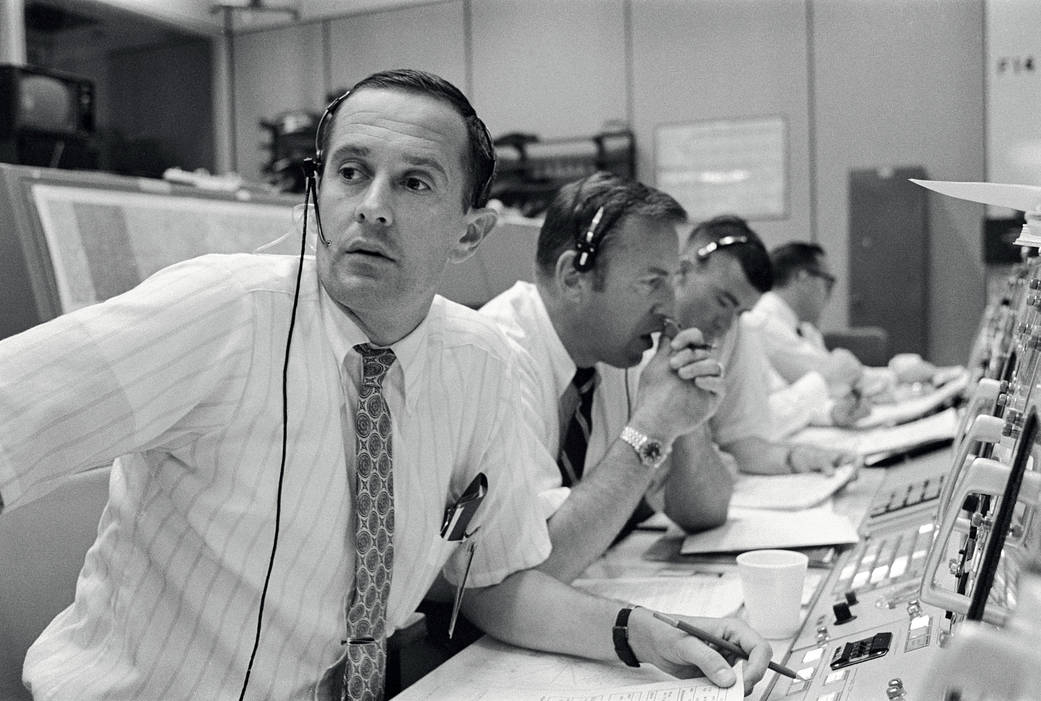
Spacecraft communicators at NASA Mission Control in Houston monitor Apollo 11 during its lunar landing mission, July 1969. The same signals were received simultaneously by tracking stations in other countries. Photo: NASA (public domain).
Related reading: Why NASA Named the JWST After a Manager — the administrator who ran the agency through the Apollo buildup was not an astronomer, and that choice says something about how the program actually worked.
The Independent Evidence That Proves the Moon Landing Was Real
The case for Apollo doesn't rest on NASA's word. It rests on separate lines of evidence gathered by different countries, with different instruments, for different reasons. What persuades me isn't any one of them. It's that methods with nothing in common keep landing on the same answer.

A visualization of the physical record left on the Moon: the Lunar Module descent stage, a laser beam striking a retroreflector array, and an orbiter passing overhead.
Lunar rocks and soil. The Apollo missions brought back roughly 382 kilograms of rock and soil, catalogued in NASA's Lunar Sample Compendium. The material carries the marks of a long stay on an airless surface: solar-wind particles driven into the grains, micrometeorite impact pits, and a mineralogy and exposure history that set it apart from terrestrial rock. It has been distributed to researchers around the world, and it has anchored decades of planetary science in laboratories that answer to nobody at NASA.

A visualization of Apollo sample study: researchers examining lunar material and the surface-exposure features — implanted solar-wind particles, micrometeorite pits — that distinguish it from rock formed on Earth.
Laser retroreflectors. Apollo 11, 14, and 15 each left corner-cube reflector arrays on the surface at documented coordinates. A corner cube throws light straight back the way it came, so a telescope aimed at those coordinates recovers a handful of photons whose round-trip timing is far tighter than anything bare regolith produces when it scatters light in all directions. The Apache Point installation in New Mexico is built to pin that range down to about a millimeter. This is the evidence I would hand a skeptic first, because it asks nobody to trust a photograph. It is a measurement, still being taken, aimed at coordinates written down before the missions flew.
What I find more telling is who else is on the target list. Two Soviet Lunokhod rovers carried reflectors of their own, and the International Laser Ranging Service catalogues all five arrays — three American, two Soviet, deployed between 1969 and 1973 — as targets in one shared program. The USSR was not standing outside this experiment. It was inside it, with hardware on the ground. The ranging is genuinely difficult, and I would rather say so: of roughly forty stations in the ILRS network, only a few have ever been equipped to reach the Moon, and three are listed as currently operational. Repeatable is not the same as casual.
Related reading: How Close Was the Moon to Earth 2.5 Billion Years Ago? — those same laser returns are how we know the Moon is drifting away from us, a few centimeters every year.
Third-party spacecraft imaging. In 2008, Japan's SELENE (Kaguya) orbiter photographed the Apollo 15 landing area and found a bright "halo" on the surface, consistent with regolith blown outward by the lunar module's descent engine. JAXA then built a three-dimensional view of the same terrain from the camera's stereo pairs and set it beside a photograph the Apollo 15 crew took standing on the ground. The two line up. At ten meters per pixel the orbiter could not resolve anything as small as a boulder, but the skyline it produced from orbit is the skyline in the astronauts' picture. NASA's Lunar Reconnaissance Orbiter has since imaged the sites at far higher resolution, showing descent stages, abandoned science packages, and the tracks that astronauts and rovers cut into the dust.
Related reading: Why Orbital Data Centers Need Giant Radiators — the brutal physics of operating hardware in space, and why the environment Apollo worked in is so unforgiving.
Independent tracking. Where a spacecraft actually is can be worked out from the ground by anyone with the right antennas. Apollo's transmissions were received well outside NASA's network, and direction plus Doppler shift together tell you where a signal originates and how fast the source is moving away. That is a measurement of the transmitter's position. It is not an act of trust in a broadcast.
The cover-up problem. Whatever a fake would have required, it would have had to hold across six missions, and across hardware, documentation, procedures, and timelines that still line up with one another today. Physicist David Robert Grimes tried to put a number on how long a secret like that could survive. Calibrating a simple probability model against real conspiracies that did eventually break, his 2016 paper in PLOS ONE ran the Moon landing as a test case, using NASA's peak 1965 workforce of about 411,000 as the number of people in on it. The model gave it under four years. That is a thought experiment rather than a headcount of necessary conspirators, and it deliberately ignores exposure from outside — foreign tracking, foreign scientists, foreign spacecraft. The narrower point still holds: large secrets are structurally fragile. This one has had fifty-seven years to break, and no verifiable insider document, physical evidence, or testimony has ever emerged.
So, was the Moon landing fake? No. And the reason isn't that NASA says so.
| Hoax Claim | Evidence Against It | Psychological Factor |
|---|---|---|
| The U.S. faked the landing to win the Space Race | The USSR had its own tracking and radar network and every incentive to expose a fake; nothing it released ever contradicted the missions, and nothing has surfaced from Russian archives since | Motivated reasoning; treating powerful institutions as inherently deceptive |
| NASA hired Kubrick to film fake Moon sets | The claim originates in Kaysing's 1976 book; Capricorn One (1978) later popularized the general idea of a staged NASA mission, though it concerns Mars and has no Kubrick connection. No record ties Kubrick to NASA in any capacity | Narrative appeal and pattern-seeking through pop culture |
| Visual anomalies (flag motion, shadows, missing stars) prove a studio setup | Each is explained by lunar lighting conditions, vacuum physics, and camera exposure settings | Confirmation bias; fixating on anomalies while dismissing technical explanations |
| "Only NASA says we went" | Lunar samples studied in laboratories worldwide, foreign tracking stations, Japan's SELENE orbiter, and a laser-ranging program whose target list includes two Soviet reflectors alongside three American ones | Distrust of official sources overgeneralized to all institutions |
| "A conspiracy this big couldn't stay secret" | Grimes (2016) modeled the hoax using NASA's peak workforce as the number of insiders and found it would likely break within four years — an illustration of how fragile large secrets are, not a headcount; hoax belief also clusters with other conspiracy theories rather than Apollo-specific evidence | Conspiracist worldview; desire for special knowledge and a sense of control |
Related reading: Goldilocks Zone: What It Really Means — why the popular science explanation gets the numbers wrong, and what the real data actually says.
Flat-earthers have a favorite argument: it looks flat when you look at it. That is the whole case. Yet Aristotle had answered it more than two thousand years ago without leaving the ground. During a lunar eclipse, the shadow the Earth casts on the Moon has a curved edge — every time, from every location. Travel far enough north or south and different constellations come into view. Neither observation needs equipment. Both need a willingness to trust a measurement over an impression.
That last part is where the Moon hoax lives too. When something is hard to understand from the outside, the mind reaches for a shortcut, and a hidden hand pulling strings is often easier to accept than the engineering. That isn't a failure of intelligence. It's how people handle uncertainty — and it is exactly the gap a conspiracy theory is shaped to fill.
The evidence has been sitting in the open, independently checkable, for more than half a century. Nobody can be made to look at it; that part is a personal decision, and science can inform it but not make it. What I would say is that the looking is worth doing. Sit with the measurements long enough and the conspiracy tends to come apart on its own, quietly, without anyone having to argue you out of it. Explore more at thesecom.net.
Related reading: Who Was Vera Rubin? — the astronomer who spent a career proving most of the universe is invisible. And she was not the only one: Women in Science: Astrophysics and Cosmology follows the wider story.
About the Author: James is a writer and researcher at History Meets Science, with a professional background in the metals and materials industry. The focus here is on topics at the intersection of space history, scientific discovery, and the history of ideas — with particular attention to how evidence shapes, and sometimes fails to shape, public understanding. This article draws on peer-reviewed research in psychology and cognitive science, NASA mission records, and findings from independent scientific institutions in several countries.
Frequently Asked Questions
Who started the Moon landing hoax theory?
Bill Kaysing, in a paperback he published himself in 1976. He is usually introduced as a Rocketdyne insider, which is true only in the narrow sense that he worked there. His job was in technical publications — accounts differ on the exact title, but none place him in engineering — and he left in 1963, six years before Apollo 11 flew. His degree was in English. The Kubrick rumor comes from the same book, and no record has ever tied Kubrick to a NASA production.
How do laser retroreflectors prove the Moon landings happened?
Because they turn the question into an experiment that can be rerun. The arrays are passive: they take a laser pulse and send it back along its own path from a fixed point on the surface. What returns is a timing measurement rather than an image, so it can be checked against the coordinates the missions recorded in advance and against decades of earlier measurements. Only a few observatories in the world are equipped to make it, which makes the measurement rare — but rare is not the same as unverifiable, and the reflectors are still there.
Did people say the 2026 Artemis II Moon mission was fake too?
Yes, while the crew was still in flight. AFP's fact-checkers traced a viral image of the astronauts supposedly posed in front of a green screen to AI manipulation, and a second "proof" clip to a text-overlay glitch introduced by a broadcaster syndicating the official feed. The timing is the interesting part: the objection was ready before the footage was.
Sources & References
- Douglas, K. M., Sutton, R. M., & Cichocka, A. (2017). The Psychology of Conspiracy Theories. Current Directions in Psychological Science, 26(6), 538–542. doi.org/10.1177/0963721417718261
- Darwin, H., Neave, N., & Holmes, J. (2011). Belief in conspiracy theories. Personality and Individual Differences, 50(8), 1289–1293.
- Lewandowsky, S., et al. (2012). Misinformation and its correction. Psychological Science in the Public Interest, 13(3), 106–131.
- van Prooijen, J.-W. (2020). An existential threat model of conspiracy theories. European Psychologist, 25(1), 16–25.
- Grimes, D. R. (2016). On the Viability of Conspiratorial Beliefs. PLOS ONE. journals.plos.org
- NASA — Lunar Sample Compendium: curator.jsc.nasa.gov
- NASA — Lunar Reconnaissance Orbiter: lunar.gsfc.nasa.gov
- NASA — Artemis II Mission: nasa.gov/mission/artemis-ii
- JAXA — The "halo" area around Apollo 15 landing site observed by Terrain Camera on SELENE (KAGUYA): global.jaxa.jp
- International Laser Ranging Service — Lunar Laser Ranging: reflector locations (Apollo 11, 14, 15; Lunokhod 1 and 2), station list and operational status: ilrs.gsfc.nasa.gov
- APOLLO — Apache Point Observatory Lunar Laser-ranging Operation, project page: tmurphy.physics.ucsd.edu
- AFP / France 24 (April 11, 2026) — Artemis II lunar mission draws flood of conspiracy theories: france24.com
- Royal Museums Greenwich — Moon Landing Conspiracy Theories Debunked: rmg.co.uk
- Wikipedia — Moon Landing Conspiracy Theories; Third-Party Evidence for Apollo Moon Landings (supplementary reference only)


Comments
Post a Comment