The Black Hole Information Paradox: Why Hawking Radiation Changes Everything

My son wasn't going to let it go.
"Dad, if General Relativity says crossing Gargantua's horizon is smooth — then what does quantum mechanics say? And why do some scientists say you'd be torn apart the moment you cross?"
I didn't have an answer. So I went looking for one.
I believe history and science are inseparable. Every scientific fact we take for granted today was once a battle — fought by people, tested by time, revised by evidence. That's what draws me to these subjects. And quantum mechanics, I was about to discover, is where that battle is still very much ongoing.
I'll be honest: I don't fully understand quantum mechanics. I'm not sure anyone truly does. What I do know is this — quantum theory describes a world where particles behave like waves, and waves behave like particles. That defies everything we can see and touch. But in the microscopic world, experiment after experiment confirms it. And strangely, quantum mechanics quietly powers much of the technology we use every day — from the chips in our phones to the lasers in our televisions.
As I kept reading, one image kept coming back to me. Not from a physics textbook. From a diving platform.
My niece is an amateur platform diver. Taller than average, but with a frame that looks almost impossibly slender. Watching her dive is like watching a masterclass in clean water entry — barely a ripple, barely a sound, just a precise slice through the surface. Everything looks calm. Everything looks controlled. And yet, the injuries came anyway. Not because her technique was wrong. Because something was happening beneath that calm surface that her body couldn't prepare for.
That image stayed with me when I started reading about the event horizon — that invisible boundary in space beyond which not even light can escape. From the outside, it looks like nothing. No warning. No signal. Just a boundary.
General Relativity says crossing it is smooth and unremarkable — at least for a black hole massive enough that tidal forces at the horizon are negligible, as Gargantua would be. But the moment you bring quantum mechanics into the picture, that smooth crossing stops being something anyone can take for granted.
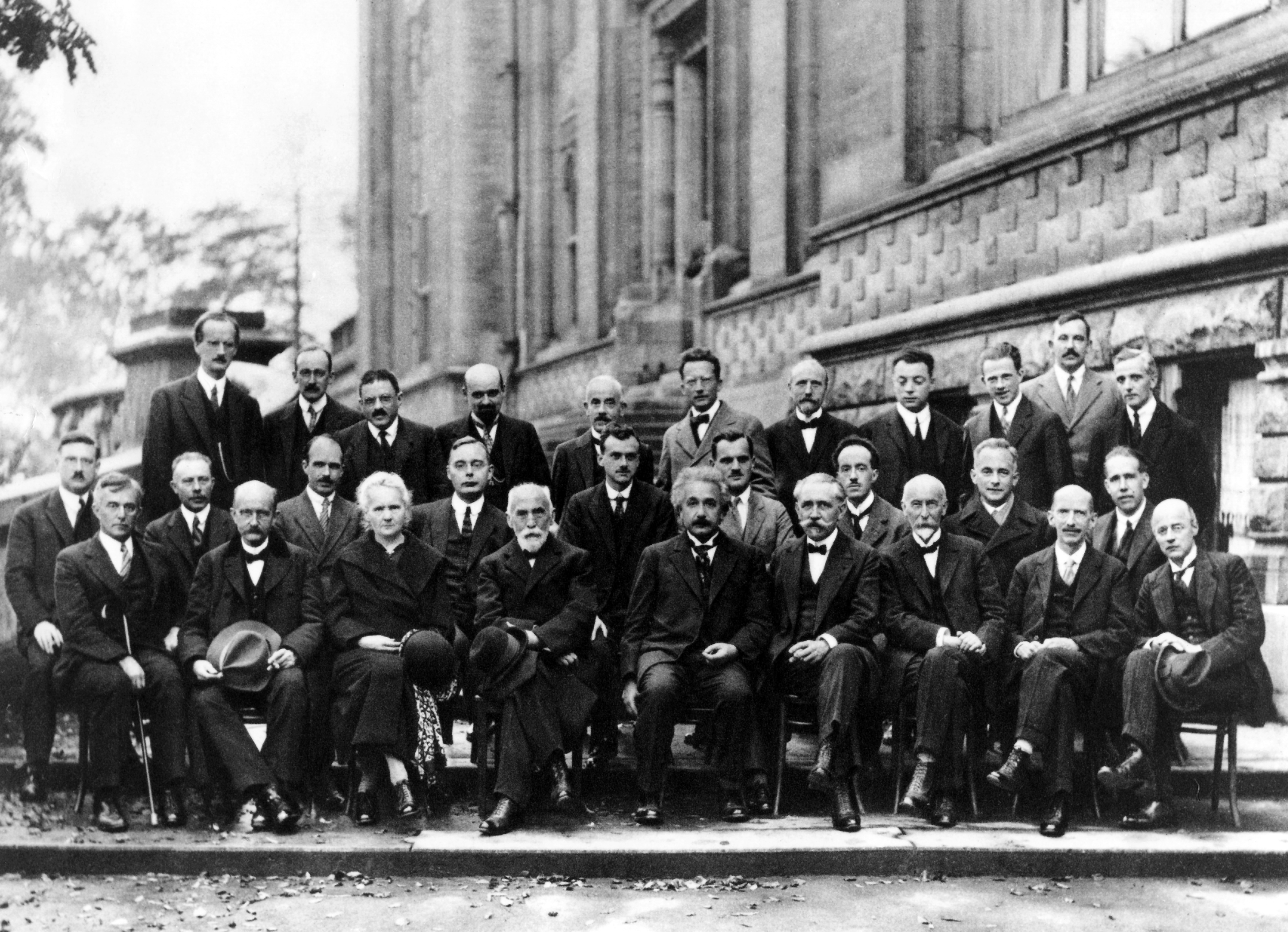
The 1927 Fifth Solvay Conference — where Einstein, Curie, Bohr, and others gathered to argue about the nature of reality. The argument never fully resolved.
What Quantum Mechanics Says About Empty Space Near a Black Hole
The question my son was really asking is this: what does quantum mechanics see at the event horizon that general relativity doesn't? The answer begins somewhere most people would not expect — in the nature of empty space itself.
In quantum physics, empty space is never truly empty. A widely used popular-science explanation describes it as constantly producing pairs of tiny particles that pop into and out of existence, usually canceling each other and disappearing almost instantly. Under normal conditions, these pairs annihilate before anything permanent happens. But right at the border of a black hole, the geometry of space changes what "almost instantly" means.
Sticking with that same popular picture for a moment: if a particle pair appears at the event horizon, one particle can fall inward while the other escapes outward. To a distant observer, that escaping particle looks like the black hole has emitted radiation — and given off a small amount of energy.
Whatever the right mechanism turns out to be, the outcome is what Stephen Hawking's 1974 calculation predicted: a very slow, continuous "leak" of energy from a black hole, driven entirely by quantum effects at its edge. Over an unimaginably long time, this process causes the black hole to very slowly shrink and eventually evaporate.
Hawking's prediction is not that black holes explode — it is that they whisper themselves out of existence, one escaped particle at a time, across timescales longer than the current age of the universe.
The leak is real, according to the framework. The consequences of that leak, however, are where the deeper trouble begins.
The Information Paradox: What the Black Hole Forgets
Ordinary quantum theory holds that information about a system's past is never truly destroyed. Physicist Matt Strassler, writing on his blog Of Particular Significance, explains this principle clearly: if you could reverse any quantum process perfectly, you could in principle recover how it started — many different beginnings should not collapse into exactly the same, featureless end. This is not a philosophical preference. It is a mathematical requirement built into the structure of quantum mechanics.
Hawking's evaporation calculation runs directly into this requirement. A black hole, as it evaporates, eventually disappears into radiation that is smooth and essentially random-looking. That radiation appears to retain only a few simple properties of the black hole — its total mass, charge, and angular momentum — and nothing finer. The detailed history of everything that ever fell in — its structure, its arrangement, its internal state — seems to be permanently lost.
| Framework | What it says about information | Conflict |
|---|---|---|
| Standard quantum mechanics | Information is always preserved in some scrambled form; no process truly erases it | — |
| Hawking's evaporation calculation (1974) | Radiation leaving a black hole retains only mass, charge, and angular momentum; finer details appear erased | Contradicts quantum preservation rule |
| General Relativity | No constraint on what happens to information; spacetime geometry is the primary concern | Silent on the conflict |
This is the black hole information paradox: quantum mechanics says information cannot be destroyed; Hawking radiation appears to destroy it. The paradox is not a gap in knowledge waiting to be filled — it is a direct collision between two tested theories, each internally consistent, each producing incompatible answers about the same object.
The Firewall Paradox: Where the Collision Becomes Physical
The firewall paradox sharpens that collision into something almost tangible. It was formulated in 2012 by Ahmed Almheiri, Donald Marolf, Joseph Polchinski, and James Sully — a group now commonly referred to by their initials as AMPS — in a paper published on arXiv (arXiv:1207.3123). Their argument asks a precise question: what actually happens at the event horizon of an old black hole if both Einstein's smooth spacetime and quantum information rules are simultaneously required to hold?
General relativity's answer has always been: nothing special. A large black hole's horizon is not a physical surface. An observer falling through it should feel nothing remarkable at that moment — the experience would resemble drifting through an unremarkable region of space. The horizon is a point of no return, not a wall.
Quantum mechanics, combined with Hawking radiation and the requirement that information not be destroyed, points somewhere very different. To keep information from being lost — or from existing in two places at once, which quantum mechanics also forbids — the horizon of an old black hole might instead be a region of intensely high-energy quanta. In that scenario, anything crossing it would not drift through calmly; it would be incinerated on contact.
This is the firewall. It is worth being precise about its status: the firewall is a proposed resolution, not a confirmed feature of nature. AMPS themselves presented a burning horizon as the most conservative way out of a contradiction — not as something anyone has observed. And that contradiction is the real point. The problem is not simply that the two pictures disagree; it is that you cannot keep all three of the following at once:
- No drama at the horizon — an infalling observer feels nothing special (general relativity's requirement)
- Information is never destroyed — quantum mechanics' core requirement
- Ordinary quantum field theory holds near the horizon — the standard assumption used to derive Hawking radiation in the first place
As the AMPS paper demonstrates, one of these three has to give. The firewall paradox does not identify which one. It only confirms that the three cannot all be simultaneously true.
And for a long time, physics could not decide which.

Three foundational concepts in quantum mechanics — superposition, entanglement, and the uncertainty principle. All three bear on what quantum theory predicts at a black hole's edge.
Why This Particular Collision Is So Hard
What makes these problems — Hawking radiation, the information paradox, and the firewall — collectively significant is not simply that they were unsolved. Physics has many open problems. What is significant is the specific structure of the impasse.
General relativity and quantum mechanics are not merely two different theories pointing at different phenomena. Each has been tested, confirmed, and refined across decades of experiment. Each is internally consistent. And a black hole is the only place in the universe where both are forced to apply at the same time — where the extreme gravity of relativity and the quantum behavior of the very small cannot be separated from each other.
The paradoxes described here are not failures of understanding. They are the result of applying two reliable frameworks to the same object and finding that the answers refuse to agree.
What Changed After 2019: The Page Curve
For decades, the picture I've described — two tested theories colliding with no way to choose between them — was simply where the subject sat. Then, beginning around 2019, the ground shifted. Not because anyone proved a theory wrong, but because physicists found a way to redo Hawking's calculation far more carefully.
The key object is something called the Page curve, named for physicist Don Page. The idea is this: if information really does escape an evaporating black hole, then the disorder — the "entropy" — of the outgoing radiation should rise for a while and then fall back toward zero as the black hole disappears, the radiation carrying its hidden details out with it.
Hawking's original calculation showed only a steady rise, never a turn back down. That mismatch is the information paradox, restated in the precise language of entropy.
Between roughly 2019 and 2020, separate groups of physicists — among them Geoffrey Penington, and a team including Ahmed Almheiri, Netta Engelhardt, and Donald Marolf — recalculated that entropy using tools drawn from quantum gravity. They found that certain contributions everyone had previously left out, regions later nicknamed "islands" and traced to geometric structures called replica wormholes, bend the curve back down at the expected moment.
Done with these corrections included, the math reproduces the Page curve. In plain terms: calculated carefully, the equations point toward information being preserved after all.
The shift in mood was real. As one widely cited account in Quanta Magazine described it, physicists had come close to resolving a paradox that had bedeviled the field for nearly fifty years, and many now say with some confidence that information does, in fact, escape a black hole.
Why the Deepest Question Is Still Open
So is it solved? Here is where I have to be careful — because the headlines and the physicists who did the work do not quite say the same thing.
The Page-curve results are genuine and widely accepted, but they arrive with conditions attached. Most of the calculations were carried out in simplified, lower-dimensional model universes — clean laboratories for the mathematics, but not the universe we actually live in.
And the researchers themselves are blunt about what remains. They have shown that the entropy follows the right curve; they have not yet mapped the step-by-step physical process by which a specific piece of information climbs back out of a real black hole. One of them described the breakthrough not as the end of the problem but as, at most, the end of the beginning — a single corner of a paradox that has only multiplied as people look closer.
And notice what the Page curve does not settle: my son's original question. Whether an astronaut crossing Gargantua's horizon drifts through calmly or is destroyed at the boundary — the firewall question — is precisely the piece the new work leaves untouched. Proving that information eventually escapes does not, on its own, tell you what waits at the edge for someone falling in.
What a distant observer sees at a black hole is, in a sense, a measurement problem on a cosmic scale. The same event — something crossing a horizon — appears smooth from one theoretical vantage point and catastrophic from another. The diving platform came back to me here: clean entry seen from outside the water, something else entirely at the boundary.
Both descriptions are drawn from tested physics. The universe has narrowed the question over the past few years, but it has not yet handed us the one answer my son wanted. Or perhaps it has, and we simply lack the instruments to ask the question properly.
Frequently Asked Questions
Has Hawking radiation ever been directly observed?
Not from a real black hole. The rate of emission from a stellar-mass or larger black hole is so vanishingly small that no instrument we've built comes anywhere close to measuring it.
Laboratory "analogue" systems — for example, sound waves in ultracold fluids engineered to imitate an event horizon — have produced Hawking-like emission that supports the underlying idea, but that is a stand-in, not the genuine article. Hawking's math says the radiation is real; direct astrophysical confirmation remains, for now, beyond the reach of observation.
Does the firewall paradox mean that falling into a black hole would definitely kill you instantly?
Not necessarily — and the honest answer is that we don't know. If information must be preserved and standard quantum field theory holds near the horizon, then a wall of high-energy radiation might be waiting at the crossing point.
But the AMPS argument itself tells us that at least one of those assumptions has to be wrong. Which one? That's what remains unsettled. Whether an infalling observer crosses smoothly or meets something catastrophic at the boundary depends entirely on which piece of physics eventually gives way.
What is the connection between the information paradox and the firewall paradox?
The firewall grows directly from the information problem. Once Hawking's calculation suggested that evaporation erases information, physicists who refused to accept that tried to save it — while holding on to standard quantum field theory near the horizon. What they found was the firewall. It is what you get when you attempt to fix the information paradox without letting go of general relativity's smooth-horizon picture. One unsolved problem, pulled on hard enough, produces a second.
Are there proposed solutions to these paradoxes?
Yes, and the landscape has shifted in recent years. The most influential development is the "island" calculation of 2019–2020, which recovers the Page curve and is widely read as strong evidence that information is preserved.
Older and complementary ideas remain in play: black hole complementarity holds that no single observer ever sees both the interior and the outgoing radiation at once, so there may be no contradiction for any one person; other approaches modify quantum field theory near the horizon, or draw on holography and the AdS/CFT correspondence. None yet explains, step by step, how information escapes a real astrophysical black hole — and the firewall question in particular is still actively debated.
Sources & References
- Wikipedia — "Hawking Radiation": Read the full Hawking radiation overview on Wikipedia
- Wikipedia — "Firewall Paradox": Read the Wikipedia entry on the black hole firewall paradox
- Matt Strassler — "The Black Hole Information Paradox, Part 1" — Of Particular Significance: Read Matt Strassler's explanation of the black hole information paradox
- Almheiri, Marolf, Polchinski & Sully (AMPS) — "Black Holes: Complementarity or Firewalls?" (2012): Read the original AMPS firewall paper on arXiv (arXiv:1207.3123)
- Ethan Siegel — "How does Hawking radiation really work?" — Big Think: Read Ethan Siegel's detailed breakdown of how Hawking radiation actually works
- George Musser — "The Most Famous Paradox in Physics Nears Its End" — Quanta Magazine (2020): Read the Quanta Magazine account of the Page-curve breakthrough
- Almheiri, Engelhardt, Marolf & Maxfield — "The Entropy of Bulk Quantum Fields and the Entanglement Wedge of an Evaporating Black Hole" (2019): Read the entanglement-wedge paper on arXiv (arXiv:1905.08762)
- Penington, Shenker, Stanford & Yang — "Replica Wormholes and the Black Hole Interior" (2019): Read the replica-wormhole paper on arXiv (arXiv:1911.11977)
- Almheiri, Mahajan, Maldacena & Zhao — "The Page Curve of Hawking Radiation from Semiclassical Geometry" — JHEP (2020): Read the Page-curve calculation on arXiv (arXiv:1908.10996)
This argument is not new.
In 1927, in Brussels, some of the greatest scientific minds in history gathered at the Solvay Conference. Einstein on one side. Bohr and the Copenhagen school on the other. The dispute was not between General Relativity and quantum mechanics — not yet. It was a battle fought inside quantum mechanics itself: over whether the theory was complete, whether nature was truly probabilistic at its core. Two interpretations of reality. Both defended by minds that changed history. Neither willing to give way.
I'll save that story for another time.
But here is what matters for now: nearly one hundred years later, neither side has been proven wrong. Quantum mechanics explains the microscopic world. General Relativity explains the large-scale universe. Both are right. And a black hole is the only place in the universe where both theories are forced to apply at the same time.
That's where my son's question led me.
I still don't have a clean answer for him. On the part he was really asking about — what happens to a body at the boundary — physics doesn't have one either, not yet. But maybe that's the point. The best questions in history were never the ones with easy answers. They were the ones that made the next century of science possible.
My son asked a good question.
I think that's enough physics for one day. My head is spinning — and all of this started because I watched a movie with my son.
Last reviewed: August 2026
For more, visit www.thesecom.net


Comments
Post a Comment